
Delaware is rewriting its banking code for the first time since 1981 to capture the regulated stablecoin market, once a world-leading corporate registration hub, is Delaware crypto the next big thing?
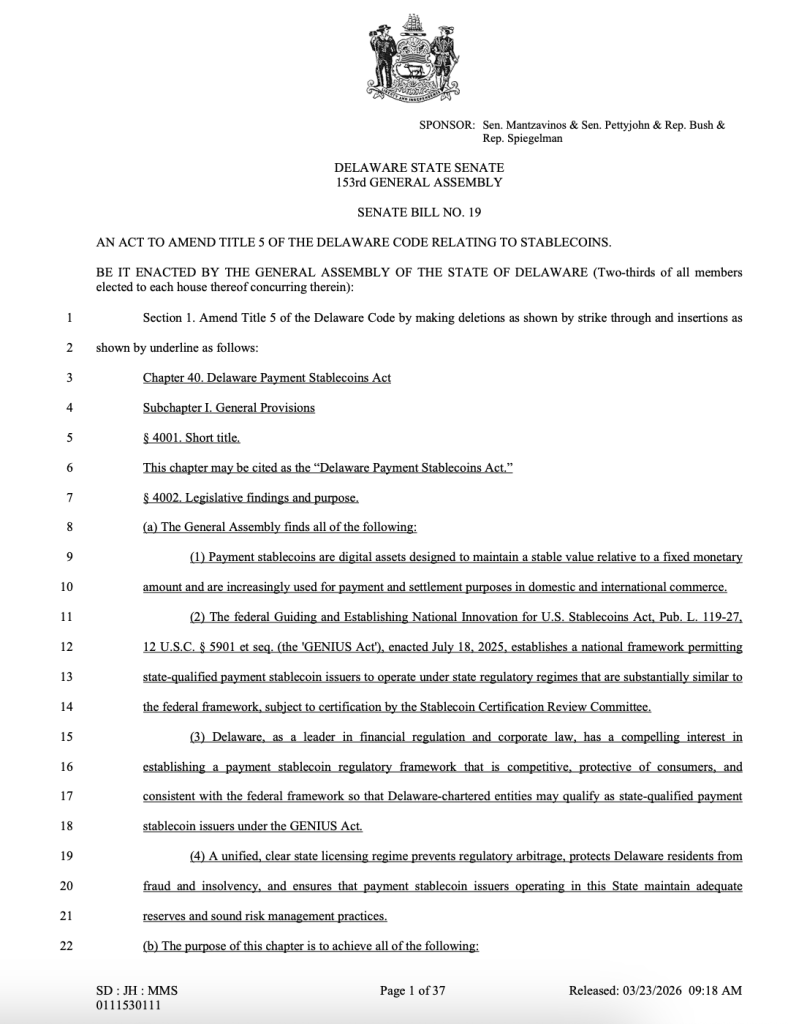
Senate Bill 19, introduced Monday, proposes a bespoke licensing regime that treats stablecoin issuers less like tech startups and more like financial institutions under the direct supervision of the State Bank Commissioner.
This is a strategic counter-offensive. After losing major industry players like Coinbase to Texas last year, Delaware is leveraging its status as the incorporation capital of the world to set a new standard for digital assets. The message to the market is clear: the state is no longer relying on passive corporate friendliness; it is building active regulatory infrastructure.
- Legislative Scope: Senate Bill 19 creates a specific licensing framework for issuers under the Delaware Payment Stablecoin Act.
- Market Friction: The move aims to reverse the exodus of crypto firms triggered by dissatisfaction with the Chancery Court.
- Federal Alignment: Definitions in the bill mirror the federal GENIUS Act to ensure future regulatory compatibility.
How the Delaware Payment Stablecoin Act Works
Senate Bill 19 is not symbolic. It is a banking framework.
Placing stablecoin issuers under the State Bank Commissioner means strict reserve auditing and solvency standards. This is not a money transmission law gray area anymore. It is institutional-grade infrastructure with real teeth.
The bill explicitly adopts language from the federal GENIUS Act. That is deliberate. Issuers licensed in Delaware will not face obsolescence when Washington finalizes federal guidelines. The frameworks are designed to align.
The bifurcation is clear. You are either a licensed, bank-grade issuer in Delaware or you are operating in the regulatory wilderness. That distinction is exactly what institutional investors need to start holding large stablecoin balances with confidence.
The politics behind the bill matter too. Coinbase reincorporated in Texas last year over issues with Delaware’s Chancery Court. Governor Matt Meyer’s administration is using this bill to stop the bleeding. A tailored regulatory environment is Delaware’s bet to recapture the jobs and tax revenue it has been losing.
The liquidity implications are direct. Compliant, state-chartered stablecoins carry less counterparty risk. If Delaware-licensed stablecoins get treated as cleaner collateral, DeFi protocols and exchanges start prioritizing them over offshore alternatives. Regulatory clarity historically precedes liquidity expansion.
But the barrier to entry rises with it. Banking framework language means capital requirements that will flush out smaller algorithmic and under-collateralized projects. Circle and Paxos benefit. Everyone else gets squeezed.
The stablecoin market was already trending toward winner-take-all. Delaware just accelerated it.
Delaware Crypto Ambitions: State Action Preempts Federal Gridlock
Delaware is capitalizing on a federal power vacuum. While the conflict over SEC oversight continues to stall comprehensive national legislation, states are moving to capture the market. By aligning its definitions with the proposed federal GENIUS Act now, Delaware is positioning its license to potentially serve as a passport under future federal regimes.
This creates pressure on Congress. If Delaware establishes a functional, high-volume banking framework for stablecoins, it sets a de facto national standard.
The official statement from Senate Democrats emphasizes “democratizing financial services,” but the subtext is regulatory arbitrage. Delaware wants to be the jurisdiction that defines what a compliant digital dollar looks like before the Federal Reserve does.
Delaware built its legacy on corporate law. Now it is betting it can build the same moat around digital dollars. The state is not waiting for permission from Washington; it is writing the rulebook itself.
Discover: The best new crypto in the world
The post Delaware Moves to Regulate Stablecoins Under Banking Framework appeared first on Cryptonews.