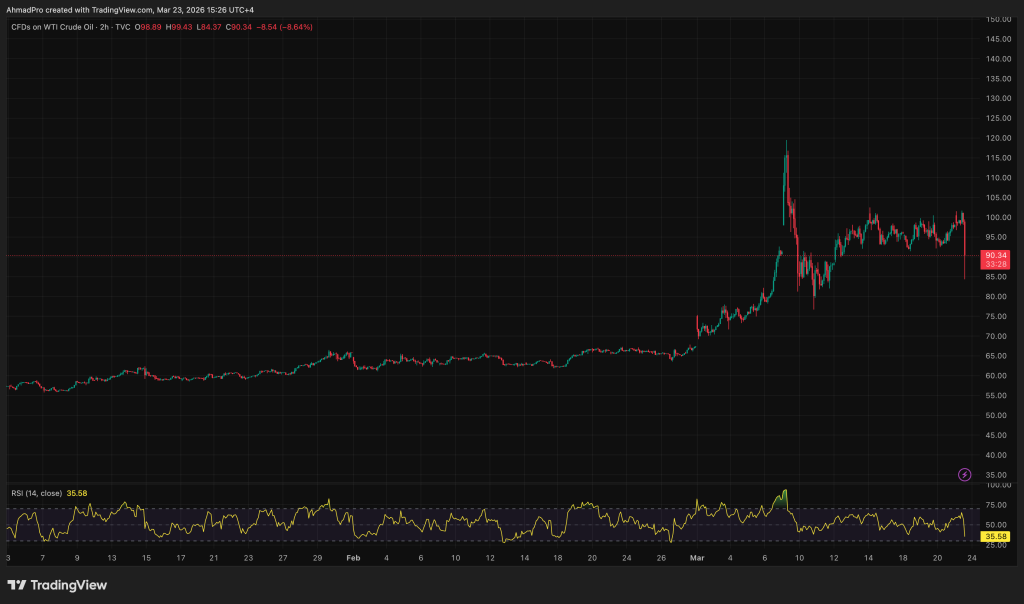

Bitcoin is failing its biggest safe-haven test of 2026 as the Strait of Hormuz crisis pushes oil toward $113. Instead of decoupling, BTC is showing a dangerous 0.68 positive correlation with crude prices, signaling that digital gold is currently trading like a risk asset.
- Correlation Spike: The Bitcoin-WTI correlation coefficient has hit 0.68, a dramatic shift from historical averages below 0.3.
- Oil Impact: Goldman Sachs projects Brent crude will average $110 through April if Hormuz flows remain at 5% capacity.
- BTC Level to Watch: Bulls must defend the $65,000 support zone to prevent a technical breakdown toward $58,000.
The Correlation Trap: Why $100 Oil Hurts Bitcoin This Time
The Strait of Hormuz is choking off 20% of global oil supply, and the crypto market is reacting with volatility rather than validation. Goldman Sachs analysts sharply raised forecasts on Monday, projecting Brent to average $110 in March and April. Futures have already reacted, with Brent hitting $113.32 and WTI climbing to $101.01 alongside President Trump’s ultimatum to Tehran.
Historically, this geopolitical chaos fuels the digital gold narrative. But the data shows a regime shift. The Bitcoin correlation with oil prices has climbed to 0.68. Why? Because the oil price crypto impact is now transmitted through inflation expectations. $110 oil ensures inflation stays sticky. Sticky inflation forces the Federal Reserve to keep rates high. High rates drain the global liquidity that Bitcoin feeds on.
Bitcoin trails money supply growth and struggles when energy costs spike. The mechanics are brutal: rising energy costs act as a tax on the consumer and the miner simultaneously. If Hormuz flows stay at 5% through April 10, Goldman’s base case, we are looking at a stagflationary environment that punishes all risk assets, crypto included.
The trade fingerprint tells you everything. Bitcoin is not bidding up on “war fear”; it is selling off on “liquidity fear.” Until the correlation breaks or oil stabilizes, the upside above $70,000 is capped by macro headwinds.
Can Whales Absorb the Macro Risk Shock?
While the paper market panics, on-chain flows suggest a divergence in conviction. Retail sentiment has fractured, but whale wallets holding 1,000 to 10,000 BTC continue to accumulate in the $65,000 to $70,000 range.
This implies smart money views the macro risk as temporary or expects a policy response, like a massive liquidity injection, to counter the oil shock.
Morgan Stanley’s recent ETF filing reinforces this institutional floor. The infrastructure is being built regardless of where crude trades next week. However, price respects levels, not narratives. The 0.68 correlation means Bitcoin is vulnerable to any further escalation in the Middle East.
The invalidation level for the bear case is clear. If Bitcoin can reclaim $72,000 while oil remains above $100, the decoupling thesis is back in play. Until then, you are trading a risk asset tethered to energy markets.
The post Bitcoin ‘Digital Gold’ vs. Hormuz Crisis: Is BTC Decoupling? appeared first on Cryptonews.